|
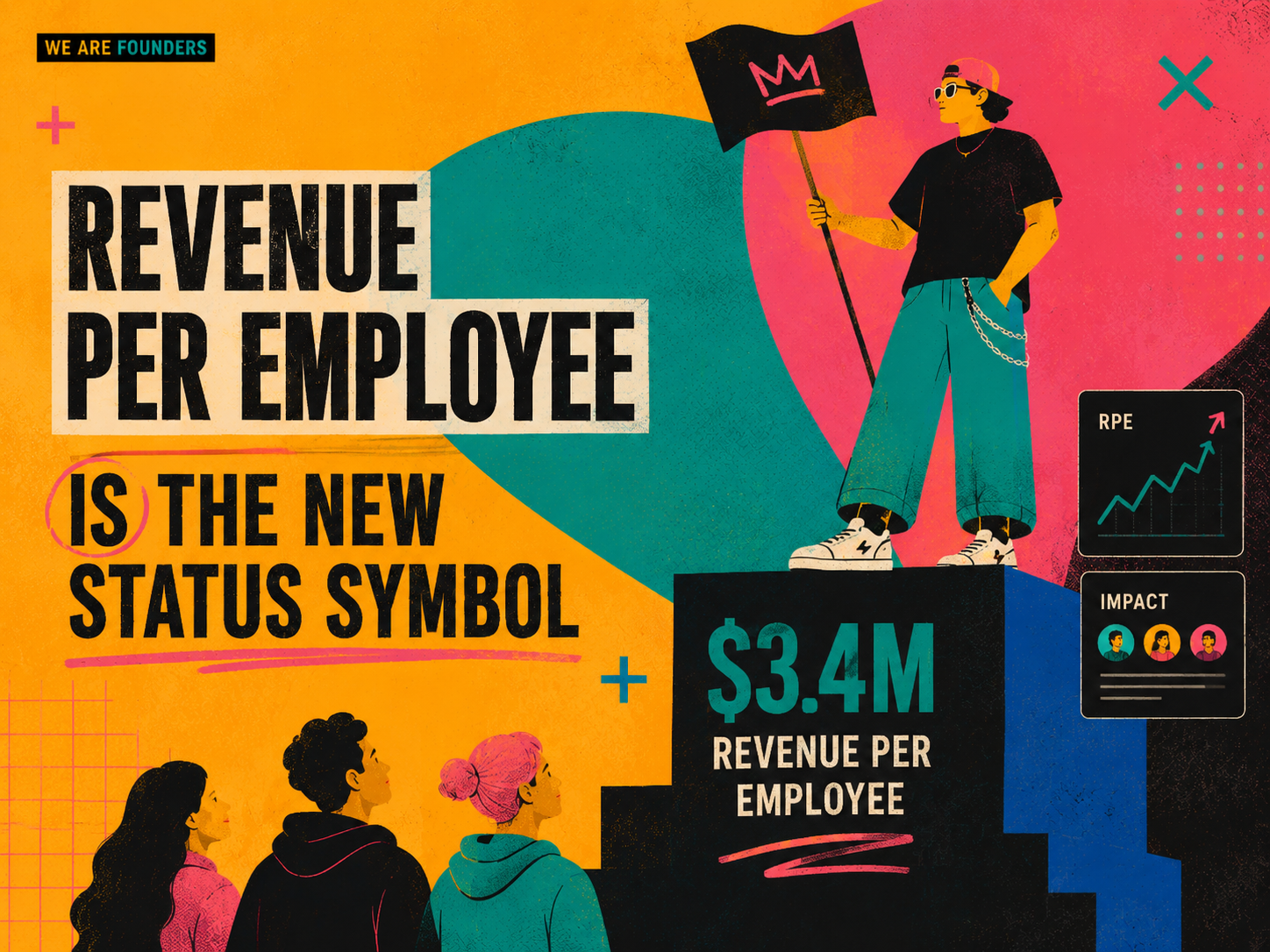
Welcome back to The Friday Brief! Last week we crossed out anything that didn't produce a paying customer, a pilot, or a real reason someone came back. Plenty of you replied with what you'd left on the page. The pattern was honest, a bit embarrassing, but useful. Thank you for that. This week we're staying in the same territory but pulling the camera back a little. The way companies scale has changed faster than the conversation around it. Let's get into it. 👇 The Team-Size Brag Is OverBen Broca says he runs a platform called Polsia that powers 5,943 companies, has hit $6.3M annualized run rate, and employs nobody. The numbers are founder-stated, but the architecture is real. Agents wake up across the platform overnight, decide each company's highest-leverage next action, execute it, and email the founder a report. He claims to run the whole thing on $800 a month in AI tooling. Pieter Levels runs Nomad List, Remote OK, and PhotoAI alone, on a combined revenue past $3M a year.  Polsia's homepage: AI agents that run your company while you sleep. Midjourney does $200M ARR with eleven employees. Gamma just hit $100M ARR with 52 people and a $2.1B valuation. Matthew Gallagher's GLP-1 telehealth platform Medvi reportedly cleared $401M in revenue in 2025 with zero employees. Pick whichever number sounds least believable. They are all real, and they are not outliers anymore. For a decade, you announced your headcount because it signaled credibility. Funded. Scaling. Serious. In 2026, the same announcement signals something different. Sequoia has started calling it "agentic leverage" in its underwriting notes. Revenue per employee has replaced team size as the metric VCs actually care about, and the gap between those two numbers is now the moat. But here's the part I think most LinkedIn posts skip. When you strip out the team, every bottleneck they used to absorb lands back on you. Theo Browne is doing seven-digit ARR on T3 Chat plus another $276K a year as a creator, and the most-quoted line from his interview last week is "I am the bottleneck." Every solo founder running an AI-heavy stack eventually says some version of it. The leverage is real, and so is the price you pay to access it. Every QA loop, support escalation, and fallback when an agent misbehaves lands on you. So here's the uncomfortable question for the weekend. If you couldn't hire anyone for the next twelve months, what would you stop doing? The answer tells you more about your business than any headcount you could put in a footer. Five Things Worth Your ⏱️ Time ⏱️Theo Browne on being the bottleneck The newest Indie Hackers interview is the sharpest solo-founder reality check you'll read this month. Theo is pulling seven-digit ARR from T3 Chat plus another $276K a year from his creator business, and the most-quoted line in the whole piece is about how he is the constraint. Read it before you tell yourself the next agent will save you. Polsia and the company-OS bet Ben Broca's claim is that one founder plus a stack of agents can run thousands of companies in parallel. The headline numbers are founder-stated and worth scrutiny, but the playbook is concrete: PM, engineering, QA, and deploy agents handing off through structured pipelines, all reporting back daily. The most interesting company-OS attempt shipped this year, whether you buy the metrics or not. Find out more about Polsia here. indiehacker.news A daily two-line digest of what indie hackers are actually talking about. Zero takes, zero filler, formatted closer to a sports scoreboard than a newsletter. Bookmark it, scan it with coffee, ignore the rest of your feed for ten minutes. 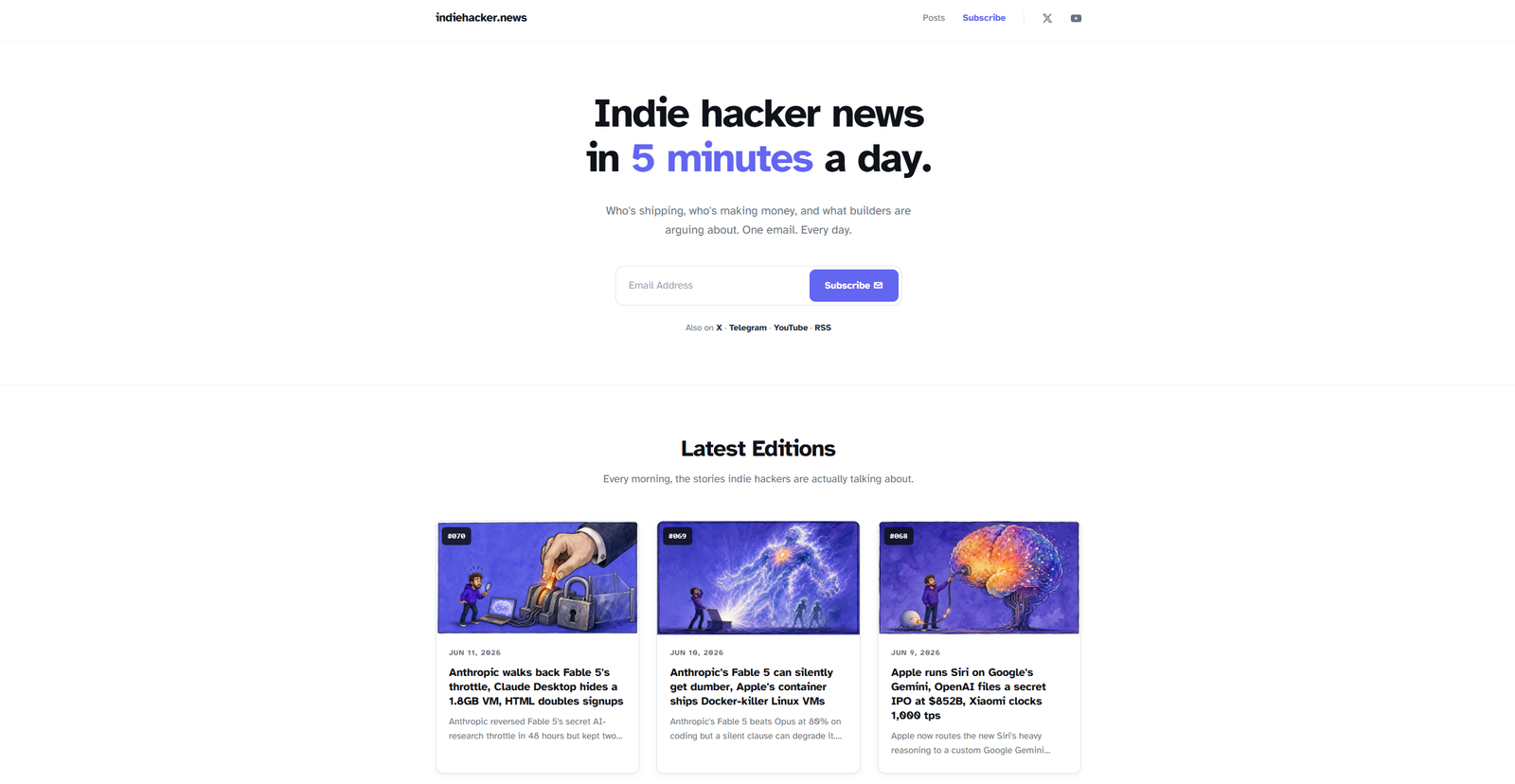 indiehacker.news homepage: daily five-minute digest of stories indie hackers are discussing. Hasaam Bhatti from zero to $30K MRR Non-technical founder, never wrote code, used Cursor over a weekend, hit $10K MRR inside 30 days and $30K MRR a few months later. The build took 48 hours. The distribution that made the build matter, a coaching program he bought into two years earlier with thousands of active Amazon sellers, was the longer and more important story. The Lean AI Leaderboard Henry Shi's open-source tracker of AI-native companies hitting serious ARR with tiny teams. Useful as a benchmark for the new revenue-per-employee bar, and as a reminder that "we're a small team" used to be a humble brag. 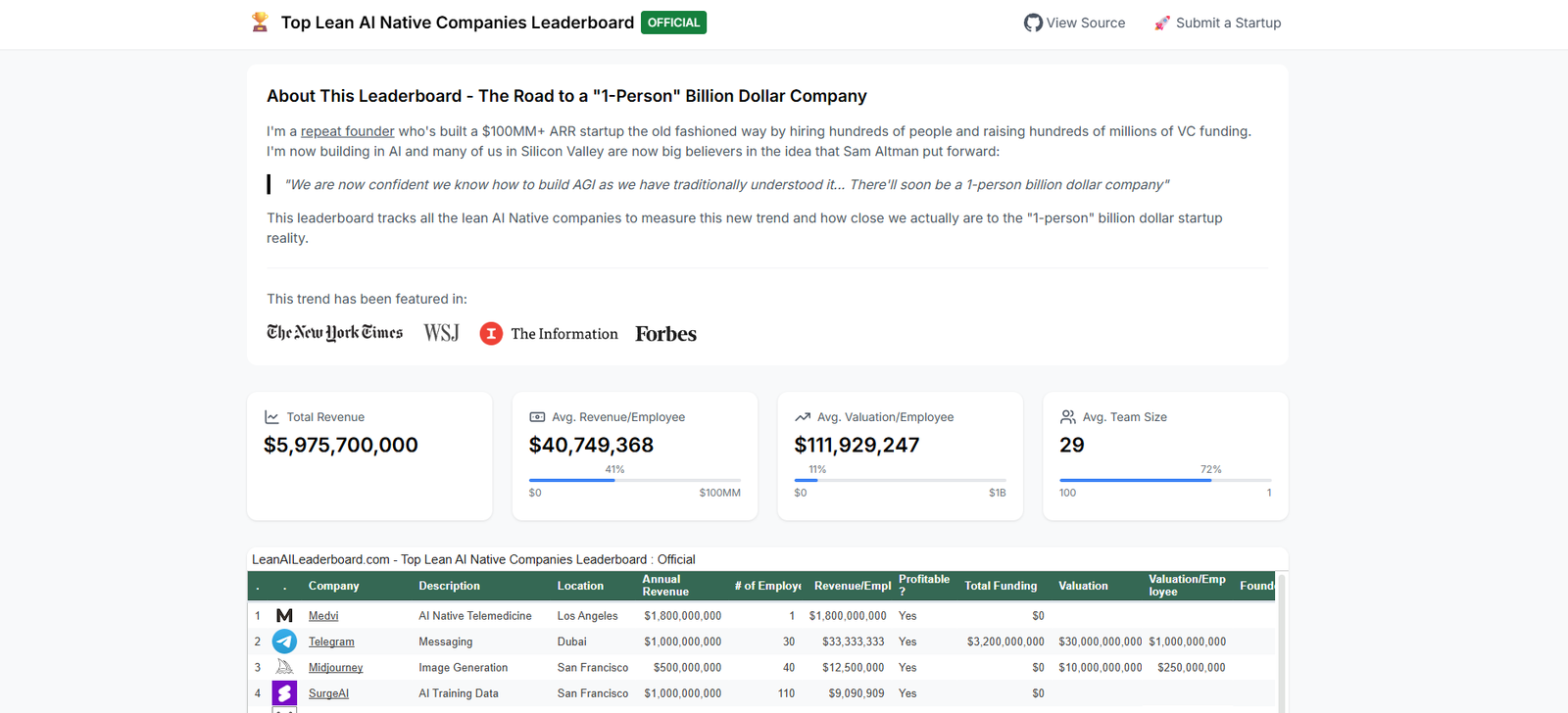 Lean AI Leaderboard: ranking AI-native companies by revenue per employee. Teardown: Revenue Per Employee Is the New Status SymbolHere are the numbers everyone is pretending not to track. OpenAI is sitting at roughly $1.5M revenue per employee on a $3.7B run rate. Anthropic, Runway, and Perplexity are above $1M per head. Midjourney is the outlier at around $18M per employee on $200M ARR. For comparison, the benchmark Jason Lemkin used to quote for a healthy SaaS company was $250K to $300K per employee. That gap is not small. It is one to two orders of magnitude, and it has moved fast enough that VCs have already rewritten how they underwrite early-stage rounds. Sequoia is using "agentic leverage" as a diligence category. The logic is simple. If your competitor can build, ship, and serve customers at five times the revenue per head you can, your headcount is not a strength. It is a structural liability. For founders, the implication is uglier than the celebrations of it. Lean is not just an aesthetic. It is a forcing function. Every role you don't fill is a role you absorb. Every agent you deploy is a process you need to design, monitor, and own the failure mode of. The math reads well. The lived experience is heavier than the spreadsheet. The takeaway is not "fire everyone." It is to stop using headcount as a signal of progress, in either direction. Neither hiring nor refusing to hire is, by itself, evidence of anything. The only number that matters is what each person, including you, is producing relative to what they cost. When you write your next investor update or your next monthly review, lead with revenue per person. Good or bad, it is the number your future buyer or acquirer is going to lead with anyway. In Case You Missed ItWe published a new founder profile this week. Noren studies how you actually write so AI stops sanding the edges off.
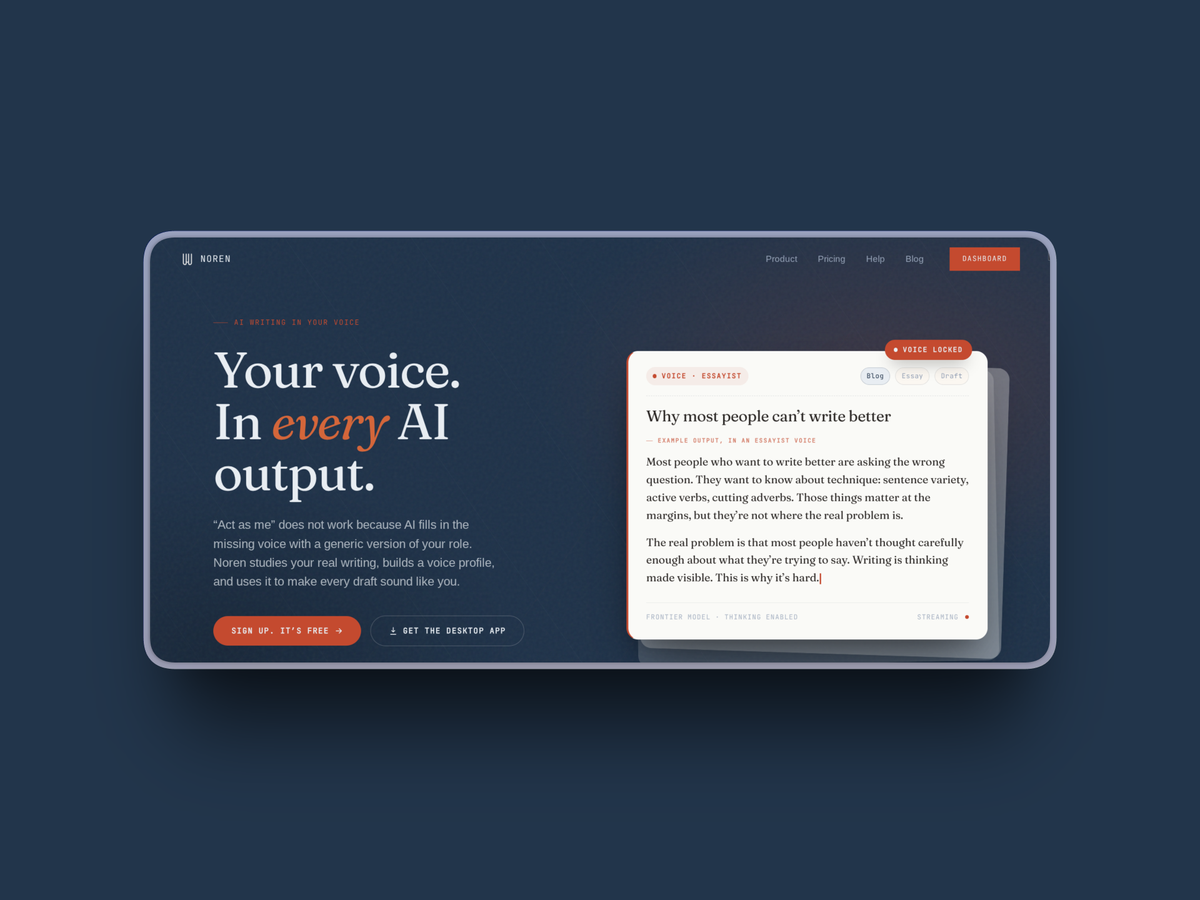
Wilfred and Onome Okajevo are two brothers building Noren, a voice extraction engine that works with any AI model. You feed it samples of your real writing, it builds a structured profile of how you actually write, and that profile travels with you across Claude, ChatGPT, Gemini, or whatever ships next month. Wilfred's framing of the problem is the cleanest version of it I've read: "It is a technical product, but the problem is deeply human: how do you let people use AI without slowly sanding away the identity in their writing?"
The bet is that as fluent AI writing gets cheaper, voice becomes more valuable, not less. Open LinkedIn for thirty seconds and the evidence is right there. Three posts about building a company, all in the same hedged-professional middle distance, none of them sticking. Noren is built to extract the structural patterns that make a writer sound like themselves rather than the model's idea of "casual." Worth a read. One small thingThe reply thread last week was the best one this newsletter has had. Genuine answers, no posing, a few honest admissions. Thank you for sending them. This week, an easier question that will tell you something just as useful. What is your current revenue per person, including yourself? If you're solo, divide your monthly recurring by one. If you're a team of three, divide by three. If you're pre-revenue, divide your remaining runway by your headcount and tell me how many months of life that buys you. Reply with the number. Anonymized and aggregated, I'll share where the WAF audience actually sits next week, and we can see how it stacks against the leaderboard. Enjoy the weekend. See you next Friday. Chris.
|