|
Future 50 is back
The fifty highest-potential startups in the world, nominated by leading investors, selected by The Generalist.
| |||||||||||||||


 |
Friends,
This is our third edition of Future 50, and the first with a sibling.
For those new to The Generalist, Future 50 is our annual compilation of the world’s most promising startups. Every year, we ask elite venture investors – at the partner level – to nominate the two companies valued at or below $200 million they are most excited about. We then parse through their responses, conduct detailed research on our side, reach out to a select group of companies for further data, and make our final choices.
Our goal has always been to give Generalist readers a way to find exceptional, high-growth startups before they become obvious to the rest of the market. We know that discovering one of these businesses early can act as a real inflection point – for investors seeking their next big win, or operators deciding where to direct their talents. Crucially, we also see it as a way of understanding where the future is heading. Which technological breakthroughs are ready for commercialization? What new behaviors are starting to appear? What trends are beginning to really take off?
After two years of running Future 50, we now have the chance to see how our awardees have fared. Of our 100 previous awardees, 6 were acquired, and 63 have announced further funding.
 |
Using public figures for valuations and acquisitions, we can get a partial sense of how these startups are distributed. Two have already become decacorns, with 15 more pegged above the $1 billion mark.
 |
Some of the standout performers to date include Modal ($15.75 billion), Polymarket ($15 billion and reported to be raising at $21 billion), Clay ($7.1 billion), Forus ($3 billion), Sakana ($2.7 billion), and Field AI ($2 billion, but rumored to raise at $10 billion). One of the year’s big acquisitions was Salesforce’s $2 billion purchase of Listen Labs, included in last year’s Future 50.
 |
This year, we’ve decided to expand on our approach. In a few weeks, we’ll be introducing Future 50’s counterpart: Generational 25.
As its name suggests, the Generational 25 is a collection of later-stage companies – at or below a $5 billion valuation at the time of nomination – that investors believe have true generational potential. The past few years have shown that the ceiling for tech companies is higher than ever, meaning that even multi-billion-dollar businesses may be in their early innings. We’ll share Generational 25 in a couple of weeks.
Given the depth and exclusivity of this reporting, Future 50 is available only to subscribers of our premium newsletter, Generalist+. For $22 per month or $220 per year, you’ll get full access to our database of breakout startups, plus our detailed rationale and exclusive traction information. If you work in tech, venture capital, or traditional investing, this edition alone should more than justify a year’s subscription.
What you can expect
By becoming a member and unlocking the full Future 50 and Generational 25, you will get:
Detailed profiles explaining what each company does and why it matters
Exclusive traction data, including revenue, customer wins, and growth figures shared with us directly
Three-point rationales explaining exactly why each company made the cut
A searchable database you can filter by geography, sector, or team size
Links to each company’s leadership
Takeaways
As above, now that we have two years of prior data, we can begin to track how this year’s Future 50 compares to previous classes. Here are a few trends we noticed:
Younger than ever
More than two-thirds of this year’s companies were founded in 2024 or later. Many are barely a year old and already selling to Fortune 500 companies, national governments, or frontier AI labs. That’s more than twice as many as in our inaugural 2024 class, and a meaningful jump from last year. Companies are increasingly capable of jumping from idea to meaningful traction.
 |
Teams are smaller
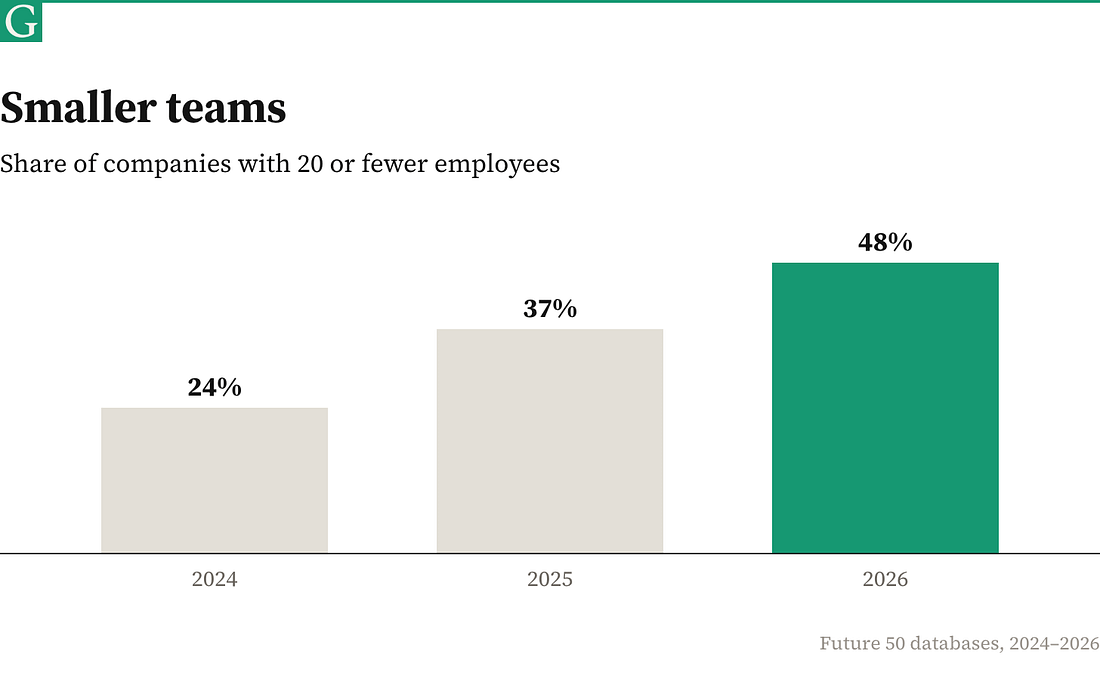
The dominant narrative is that AI is giving small teams greater leverage. At least in this population, that seems to be true. Nearly half of Future 50 awardees had 20 or fewer employees, up from 37% in 2025 and 24% in 2024.
 |
America leads
The rise of AI and deep tech has seen American companies become an increasingly large part of the Future 50. The geography has grown year over year, while the “Rest of the World” has sharply shrunk. Interestingly, Europe has grown, too, though it still lags the United States.
 |
Regionally, Silicon Valley still leads the way, though New York City is a surprisingly close second. But while San Francisco and its surroundings continue to rise, New York is shrinking, as is Los Angeles.
 |
AI everywhere, defense up, fintech down
The sectoral mix of awardees confirms what venture practitioners feel: everything is AI, with a smattering of defense and deeptech. Meanwhile, fintech and crypto went from a leading category to a fraction. This year, just one crypto company made the list.
 |
Our process
There are an infinite number of ways you might try to create a list like this one. You could collate it based on perceived status, hard metrics, personal opinion, or the opinion of ceremonial judges. We take a different approach, with a few key characteristics:
Create a valuation threshold. We set a threshold of $200 million, post-money, at the time of nomination (June 1, 2026; naturally, some companies have raised since). This threshold prioritizes companies with real traction and strong products in markets that still have plenty of room to run. Later-stage nominations now have a home of their own in the Generational 25.
Focus on nominator quality, not quantity. We contact more than 200 of the world’s best-regarded investors and ask them to nominate the companies they believe have the highest potential. We receive submissions from partners at nearly every Tier 1 fund.
Span the globe. We believe important companies will be built outside the United States. We sought out investors based in Latin America, Africa, Europe, and Asia to ensure global coverage.
Force stack ranking. We ask every investor for two early-stage companies and one later-stage company, with an explanation for each. The goal is not to collect as many names as possible, but to have nominators choose the very best companies they know.
Study each company. The Generalist reviews every nomination, reads each investor’s rationale, and studies the company through its website, press coverage, and our own research. We use this to filter the list down to a group of finalists.
Request exclusive, confirmatory information. We then contact the finalists directly and ask them to confirm their valuation at the time of nomination and share revenue, key differentiators, and any other notable traction. Some of that information is published here for the first time; the rest remains confidential but is invaluable in our assessments.
Make final judgments. The Generalist uses the information gleaned from companies to choose our final 50. We factor in the data we receive but also recognize that great companies have different commercial maturation rates.
Provide detailed descriptions and clear rationales. One of our frustrations with lists is that they are often light on detail. For each company in Future 50, you’ll find a clear synopsis of the business and a three-point rationale explaining what we liked about it and why.
In previous years, we chose not to nominate a company ourselves and displayed all companies alphabetically. This year we made two small tweaks: we randomized the order and picked one awardee of our own as an experiment.
No process is perfect, and every approach has trade-offs. But we believe that ours has consistently given us something valuable: a detailed, actionable list of potentially legendary companies, many of which we had never heard of before.
Join today to access the full list.
The Future 50
Meet 50 of the world’s highest-potential startups. Nominated by investors, selected by The Generalist...
Subscribe to The Generalist to unlock the rest.
Become a paying subscriber of The Generalist to get access to this post and other subscriber-only content.
A subscription gets you:
| Full access to all writing | |
| Exclusive interviews with leading CEOs and GPs | |
| Unlock our private database of high-potential startups |
| ||||||||||