|


 |
Photographer Bob Willoughby captured an amazing moment at an LA concert back in 1951. It’s my all-time favorite music photo.
The image shows saxophonist Big Jay McNeely performing at the Olympic Auditorium. He is hot and sweaty and breaking all the rules. The spirit of the music is so intense that he’s playing his horn while lying on his back.
It’s very campy and theatrical. But that’s not the reason why I love this photo.
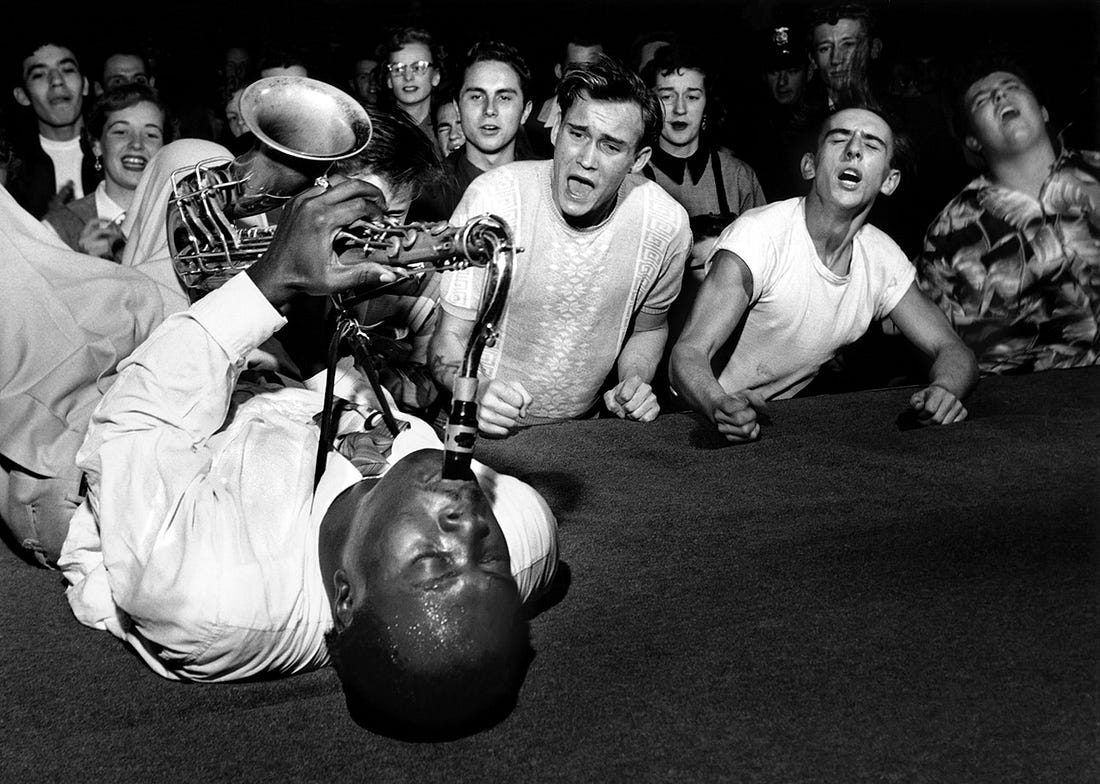 |
It’s the audience that grabs my attention. They are in a state of intense ecstasy—you can read it on their faces.
Two young men have left their seats and are leaning on to the bandstand with their mouths agape and eyes transfixed. A third one looks like he has actually achieved some transcendent out-of-body experience, and might just float away into his personal nirvana.
I know what it’s like. I still recall a sax performance I attended decades ago that was like a revival meeting—everyone of us in the room felt it. Some magical force had descended on us. We were all crazed and possessed.
We rose to our feet and swayed and screamed. Some even started chanting and singing along with the band. (I was one of them.)
You could have sent us into battle at that moment—and we would have stormed the Bastille, tearing it down with our bare hands.
Please support my work—by taking out a premium subscription (just $6 per month).
I know some of you have had similar experiences, and cherish them like I do my initiation into group-induced musical trance. It’s hard to explain them to somebody who hasn’t gone through this kind of concert mania. All you can say is the feeble excuse: You had to have been there.
But there’s one more thing I can add about these life-changing moments. It’s a simple reflection that those kinds of things don’t happen online.
You can stream Spotify all year long, and never achieve what Big Jay McNeely imparted to those fans back in 1951. No music video on YouTube or TikTok will come close.
Only live music can do this.
“Live music is even more popular than sex….84% of users believe that events give them ‘the most life.’ And 80% prefer to spend money on experiences instead of consumer goods.”
That’s not just my opinion. It’s a matter of science.
When people hear music in a group setting their brainwaves start to synchronize. The body also releases the hormone oxytocin, which makes them more trusting and willing to bond together.
That’s why so many couples, over the course of centuries, have discovered their romantic attraction at a dance or nightclub. The music actually turns them into lovers, without them even thinking about it.
For the same reason, we sing national anthems or team songs at sporting events. This creates a bond between fans that no other force can match. And it’s also why the labor movement relied so heavily on songs in building solidarity. Religious leaders, of course, have always known this, so they all have their hymns and chants.
“Recent studies conducted in real-time, in concert halls, demonstrate that people enjoy music more when the performance is live and experienced as part of a group,” explains cognitive scientist Lindsay A. Fleming.
She continues:
Live music triggers stronger emotional responses than recorded music due to the dynamic relationship between the audience and the performers. The visual cues, collective energy, and real-time responsiveness of live music engage more sensory and emotional systems than listening alone, deepening our visceral connection to the experience.
This is why live music will never die. Nothing else can replace it.
The only people who haven’t figured this out are the executives running the music industry.
Almost all the investment money in the music biz is flowing into streaming and publishing rights.
Very little is spent on developing new artists. Most of them have to launch careers on their own, with no support or guidance.
They are typically encouraged to find an audience on TikTok—instead of through live performance.
Most newspapers don’t review live music anymore. So touring artists generate little or no publicity for their work.
Ticket prices are too expensive, and loaded with hidden fees.
It’s worse than you think. The Department of Justice laid out the ugly details in a 124-page lawsuit against Ticketmaster:
Any fan who has logged onto Ticketmaster’s website to buy a concert ticket knows the feeling of shock and frustration as the base cost of the ticket increases dramatically with the addition of fees to include:
(a) “service” or “convenience” fees,
(b) “Platinum” fees,
(c) “VIP” fees,
(d) “per order” or “handling” fees,
(e) “payment processing” fees,
(f) “facility” fees, and/or
(g) any other fee or tax Ticketmaster collects from the fan, often with a cut of that fee going back to Ticketmaster.Whatever the name of the fee and however the fees are packaged and collected, they are essentially a “Ticketmaster Tax.”
Despite these obstacles, the concert business is still alive—and growing faster than recorded music.
Back during COVID, experts doubted whether nightclubs and other music venues would ever recover. It wasn’t just the virus, but also the stranglehold of digital platforms—which keep a whole generation at home and staring into screens.
But then Taylor Swift turned her Eras tour into the biggest musical moneymaker of the decade. People took notice when it became the first concert tour to surpass a billion dollars in revenue. And then, a few months later, it surpassed $2 billion too.
But those numbers don’t come close to measuring the demand for tickets. When Ticketmaster made seats available for the second leg of Swift’s tour, 14 million users tried to buy just 625,000 tickets.
It’s not just Swift and her ardent Swifties. We see many other measures of a resurgence in live music. In the UK, for example, concert revenues are growing twice as fast as recorded music revenues. A concert now starts in Britain, on average, every 137 seconds.
Live music is even more popular than sex, according to a survey of 40,000 people conducted by Live Nation. Streaming is no substitute. The same survey found that 84% of users believe that events give them “the most life.” And 80% prefer to spend money on experiences instead of consumer goods.
Tech platforms hate this. Live music is hard to scale and defies mass production. Every experience is unique. So the most powerful businesses in music ignore the audience’s hunger for live performance—and dish out formulaic TikTok-ish videos instead.
But that isn’t the way to energize music fans.
Maybe that’s why Disney’s stock dropped like a rock after it announced more short-form AI content for its Disney+ platform. For most people, this is about as exciting as day-old oatmeal. But the media companies have lost their ability to read the room.
 |
|


There is another way. A better way.
Consider the case of live music discovery platform Bandsintown. This company was launched with modest funding, but it now has 100 million users in 196 countries—and it’s adding almost a million more fans every month.
The company is a huge success by any measure—and it’s not just helping superstars. Most of the demand on Bandisintown is for emerging artists, with fewer than 250,000 followers.
But the big web platforms don’t dare try to imitate it. That because Bandisintown wants people to stop scrolling and go to a live concert. Their stated goal is to get people off their phones as quickly as possible. So Mark Zuckerberg and Elon Musk will never embrace this opportunity.
But it is an opportunity. Live music isn’t a relic from the past. It is the obvious pathway for musicians and fans now and in the future. Digital media can’t even begin to match its energy and excitement. And no chatbot will ever replicate it.
For those of us who toil away in the music ecosystem, this is our joyous destiny. Fans want to experience music live. Some will sing along with the band. Or get up and dance. And maybe even a few will experience an ecstatic trance like the one I had back in the day.
That’s worth celebrating. And facilitating. And—best of all—participating ourselves. If you have any doubts, go back and take another look at that photo of Big Jay McNeely at the top of the page.
You're currently a free subscriber to The Honest Broker. For the full experience, upgrade your subscription.
| ||||||||||

