
|


 |
“I chose cultural anthropology, since it offered the greatest opportunity to write high-minded balderdash.” — Kurt Vonnegut.
Friends,
One way I think about The Generalist’s work is as the anthropologist of a small, strange tribe.
This is not a normal tribe. It has no set territorial home, no blood lineage, no linguistic or ethnic markers. Its people have existed for generations, and its numbers still grow, though not at any rapid pace.
I am speaking of the tribe of founders. Not simply business owners — those entrepreneurs who run shops or build products though the world needs them, too — but the empire-builders. Those who, for some inscrutable reason, decide it is not enough for humans to visit the moon, we must build cities on Mars; it’s piddling to run a railroad from one city to another, it must stretch from coast to coast. Those who, on greater and lesser canvases, eschew the reasonable path to drive forward. The modern world’s amenities, innovations (and in some cases, frailties) rely disproportionately on this small, strange tribe.
You may find it fatuous to set the frame in this way. What useful container credibly possesses a Milanese orphan and a Texan heir? Or a Zen priest and a casino tycoon? What can you learn by lumping together a Chinese army officer and a dentist’s son from Dobbs Ferry?
Yet, if you could unite this tribe in a single, great room — if you could convene Leonardo Del Vecchio, Howard Hughes, Kazuo Inamori, Sheldon Adelson, Ren Zhengfei, and Mark Zuckerberg — you would find deep unities between them. They might agree on nothing, but they would share some allele, some inner posture, some foundational sense of reality and its malleability.
At least, that is what I have always believed. And what I have always hoped to investigate fully, though I couldn’t imagine it would take me much less than a lifetime.
Then, earlier this year, I decided to start. This was precipitated by two events. One was reading Henrik Karlsson’s excellent piece, “Childhoods of exceptional people,” in which the author outlines the patterns he observed by studying the early years of remarkable writers, mathematicians, philosophers, and composers. As it turns out, the childhoods of people like Virginia Woolf, René Descartes, and Alan Turing share characteristics, such as significant time alone with their thoughts and instruction from a personal tutor. As well as being an excellent read, Karlsson’s piece prompted me to think more deeply about the value of studying childhoods specifically and to consider what intriguing patterns might exist in the biographies of great founders.
The second catalyst was an unlock in capabilities – namely, the AI models released towards the end of last year. As outlined in my “Writer-Researcher’s Guide to Claude Code,” these have made it easier to find, gather, and parse massive amounts of information across sources and languages. There are still plenty of places where these models are ill-equipped, but they are sincerely exceptional at conducting massively parallel research.
Once I became familiar with Claude Code, this project was among the first I considered. Bit by bit, I began to scope out exactly what such a project might entail. In an ideal world, with no time constraints, who would I study? How many founders did that amount to? Fifty? A hundred? How many good biographies have been written on each of them? What about in other languages? If I had an army of researchers and encoders, how many variables would I try to encode for each of them? Could I make sure we captured each of them sufficiently well?
The more I dug into it, the more obsessed I became. “Saplings” is the result of this obsession. It is a multi-part series on the formation of exceptional entrepreneurs, arriving soon. But before beginning the series in earnest, I wanted to share the interest behind the project, how it came to be, and the process it entailed.
It has been formed by studying 260 entrepreneurs across more than 560 books, not to mention other sources. Each entrepreneur has been encoded with 430 different variables, from their father’s profession to the number of significant moves their family made.
Here is the full list of founders.
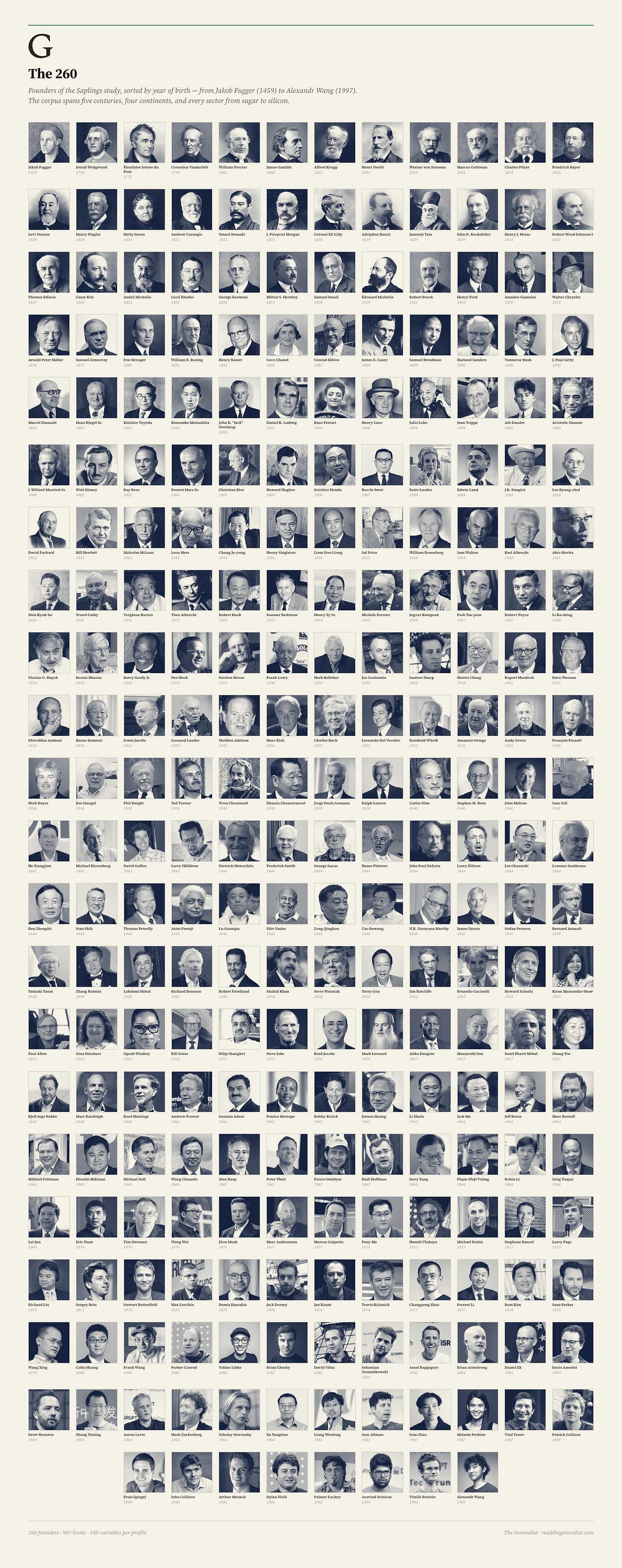 |
Before you tell me who I have missed (though I would love those suggestions, too), a few notes on the selection methodology. In short, there is none. It is explicitly a non-random sample governed by my curiosity. Because of that, you’ll notice that it skews towards technology and the modern era, even as it spans eras, geographies, scale, and impact. Some of these people built world-changing technologies that revolutionized modern life, and some…founded very popular chicken restaurants.
As you dig into this subject, you begin to realize how arbitrary various criteria become. For instance, should you study only those people who started a given company? That is what a founder means, after all. But you quickly remember (or learn) that many of the world’s most valuable enterprises were small businesses for a generation or more, before a hard-driving youngster takes the reins. Stick to the literal founder, and you would be left profiling Anna Albrecht, who ran a poky shop in Essen, rather than her sons Karl and Theo, who turned it into the grocery chain Aldi. That would miss the point entirely.
Then there are the founders who did not live to realize the fullness of their creation. Kiichiro Toyoda pivoted his family’s loom empire to building cars, but died long before it became the automotive juggernaut it is today.
What about those who grew great through the craft of investing? Is Warren Buffett a founder? In point of fact, yes, but his art is of a different kind. Does that matter?
I have made exceptions to all of my rules. Because of that, and other varied caveats, any attempts to make statistical judgments (e.g., “25% of founders started working before the age of 12”) would represent false precision. The goal is, explicitly, to look for patterns, not decide whether a certain trait has true statistical significance.
It is worth saying that this is not a valorization of these names. There are some truly terrible people on this list! Many you would not trust to watch your laptop at a coffee shop, let alone govern the lives of thousands of employees, or raise children of their own. But the point is to understand what made them who they were as entrepreneurs, not to compress their lives into an ethical judgment.
There is no way I would have been able to take on a project of this scope without the latest models. If I monastically devoted every waking second to reading founder biographies, I calculate it would have taken me nearly a full year to read the full library, and several more to encode them properly. (My efforts would have been further slowed by the fact that I do not speak Mandarin, German, or Hindi). The Generalist does not have the budget to hire twelve multi-lingual researchers, and I do not think I would readily find ones tuned to our interests even if we did.
Had we tried this a year ago, I would not have trusted the models to do a thorough and trustworthy job or maintain state across long-running tasks. Even with Opus 4.6 and 4.7, it took lots of wrangling, false starts, and mistakes over the past two and a half months.
In broad strokes, this was the process we followed:
Select a list of candidates. We started with 114 founders I wanted to study, which we eventually added to. We focused on CEO types, and chose to include those who took over a family business, provided they were the individual who drove most of its value creation. Though we initially started by focusing on tech, we broadened outside of that to capture other industries (e.g., pharmaceuticals, defense, energy, apparel) and sought entrepreneurs from geographies I was less familiar with.
Find the best resources. As you might imagine, the number of relevant books about Steve Jobs is much higher than those about, say, Tim Sweeney. At the start of the process, we set out to find as many high-quality books as possible. Though this primarily meant biographies, we also found more company or industry-focused books that touched on the childhoods of our protagonists. Wherever possible, I have purchased physical copies of these books, as well as using available digital versions. I now have quite the burgeoning founder library!
Set a rubric. As much as possible, I wanted to set out a plan from the start to ensure shifts in strategy didn’t require re-reading and re-reviewing. The rubric was one of them, though in the end, we had to make plenty of adjustments to this, too. At the beginning of the process, I set out a rubric of variables to fill in for each founder. That included biographical information (where they were born, their parents’ occupations, their birth order), the texture of their early sensory world (their local environment, the feeling of their home), the structure of their family (who held power and how), their intellectual formation (the interests that drove them), and plenty more besides. Although I didn’t want to conduct a statistical analysis, I felt it was important that we had structured information so that we could trace back potential patterns to evidence. Later in the process, we expanded this to 430 cells per founder to account for nuances that surfaced at scale.
Calibrate the standard. I had Claude conduct research and write profiles on a few founders to start. I provided feedback on what I liked and what needed improving. We used this to set a standard for future agents to attempt to meet or surpass.
Batch process. Once we had the standard, we started running batches with multiple founders. This went awry a lot, at least until much later in the process. Many of these batches inexplicably stalled, failed, or produced inconsistent output. Getting agents to focus on careful reading rather than producing output was a challenge, as was paying attention to the source materials over training knowledge.
Audit and improve. As we hit different issues, we introduced a series of checks and audits to ensure the desired work had actually been done and that we’d hit the required standard, to the extent permitted by the available evidence. I feel confident we’ve gotten to a high level of accuracy across the 111,800 variables we’ve encoded, but I am certain a great human team could find errors or clarifications. When analyzing broad patterns, these don’t matter much, but it’s worth explicitly noting.
Assess. Only at the end of the process did we review the patterns that occur. I won’t write about all of these, nor necessarily the ones that “show up the most” — as mentioned above, the moment you reduce this to statistics is the moment you lose the thread. Rather, I’ll be highlighting the ones I find most significant.
In executing these broad steps, we made a number of critical decisions that greatly helped quality and accuracy. I share these in case anyone wants to undertake a similar process or finds these methods relevant for their own work. Many of these were discovered through a lot of trial and error:
One agent per book. Early in the process, we tried to run agents that read multiple sources. That led to insufficiently deep reading and shallow extractions as Claude hit context limits and compressed valuable information. Moving to a one-agent-per-book structure helped avoid this skimming. It also helped speed up the process by parallelizing deep reading.
Split reading and writing. If you tell an agent to read and then write, it optimizes for the output. It wants to get you a written profile as soon as possible, and cuts corners on deep reading, relying on training data. Splitting those jobs up helped. It forced the reading agent to pay close attention and transcribe its findings into notes, and the writing agent to focus on crafting a great profile. Eventually, we realized you could have Sonnet conduct the reading work without loss of detail and save Opus for writing.
Create Iron Laws to prevent false confidence. A weird thing started to happen about halfway through the process — Claude started feeling itself. Once we had a decent number of founders in our rearview mirror, the system began pushing past our QA processes, almost as if it felt too good to stop and check its work. To prevent that from happening, we introduced some “Iron Laws” that named the excuses the system would use to rationalize skipping steps, for example: “You feel momentum — that feeling is the signal that QA is about to be skipped.”
Give equal credence to other languages. Even if a founder has an English-language biography, it’s worth looking for books in their mother tongue. The Italian biography of Brunello Cucinelli or the Turkish-Kurdish press on Hamdi Ulukaya both produced much richer detail. In total, 106 of the 260 candidates were bolstered by non-English sources. Getting Claude to find and assess these carefully greatly improved the depth of our findings.
Use Modal. Once I felt we had a strong process that reliably yielded good results, I started to rely on Modal (a service to run your code across multiple machines in the cloud) for parts of the process. This reduced the time on our batches (and other similar processes) considerably, likely shifting our timeline from weeks to days on some tasks.
This project has frequently made me want to tear my hair out. When you’re on the sixth or seventh round of errors and timeouts and spent tokens, you begin to think this may not be a tractable challenge. But though it is far from perfect, I think we have succeeded in building the necessary structure and depth — perhaps not to provide all the answers, but, at least, to ask better questions.
Of course, none of this would be useful without a human at the heart of it, not just in structuring the machine and stoking its fires, but in actually doing the work of studying these people, looking carefully at each of their lives. That is not something Claude, which tends towards the glib and simplistic at times, excels at, and it would be beside the point. I want to study these people, to mull over the details of their early lives, what their household was like, how their obsession formed.
And so, that is what I have been doing. Over the past couple of months, I have been reading about these people and noting the similarities and differences. There have been plenty of surprises – patterns I expected to see that arrive much less frequently than I’d imagined and others I’d never thought of.
For instance, the traditional mythology is that great entrepreneurs follow a rags-to-riches arc. I did not expect anything so facile, but anticipated more of a barbell, a split between patrician heirs taking a family business to new heights and those who had gritted their way up from nothing. What I found instead was something more interesting. What seemed to unite founders more than familial wealth, or the absence of it, was the motion of that wealth. With intriguing regularity, entrepreneurs were raised by families in flux – either losing their position, or rising to greater prominence. They endured what it meant to lose everything or saw how luck, grit, and intelligence could produce a better life. Being moved by an economic vector is a more common pattern than belonging to a specific class.
More than that, though, there has been a deepening. A sense of what it means to have been a truly obsessive child, what drive looks like and boredom, too, how pain is transmuted into motion, and where silvery moments of opportunity – those little glimpses of the future – appear in the mundane and how a person perceives them and spins them into the beginning of something bigger.
It has been a huge amount of fun and genuinely fascinating. My hope is that you will feel similarly and that it may allow us all to appreciate the act of innovation and where it first begins from a novel vantage.
See you in two weeks for Part I.
You're currently a free subscriber to The Generalist. For the full experience, upgrade your subscription.
| ||||||||||


