|
|


| ||


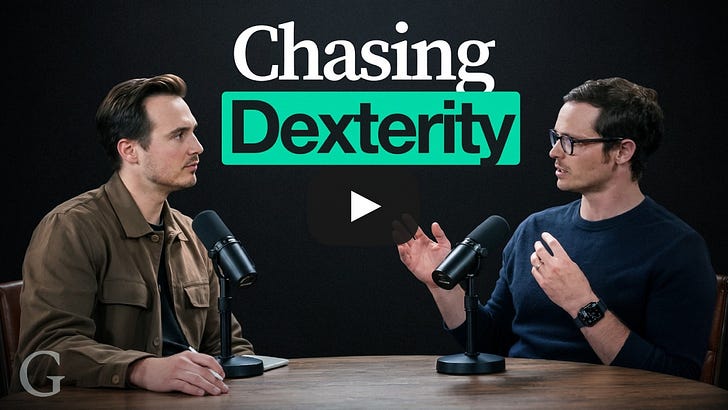
“Before fire existed, it’s hard to imagine all the implications of fire. I think the same thing will very much be true with the level of robotics that will be possible. It’s just hard to even think of all the possibilities.” – Pete Florence, Co-Founder & CEO of Generalist
Pete Florence and I began by agreeing that his company has an excellent name. Generalist builds AI for robots, including models that can begin learning a new task from a single demonstration. We talked about dexterity, the strange business of gathering physical experience for a machine, and what we might build if robots could do much more of the work.
Listen or watch on YouTube, Spotify, or Apple Podcasts.
From my notebook
We’re trying a new thing where I share a few of my thoughts from after the episodes. The moments that struck me, the tidbits that reframed my thinking, or something I just really enjoyed. Let me know if you like reading these!
Dexterity, dexterity, dexterity. Before the conversation, I was trying to think about what robotics’ equivalent of coding would be. I found myself looking for a big industry or use case – something in manufacturing or construction. Pete’s answer is dexterity. Like coding, it’s a horizontal capability that runs across fields and opens up a huge range of work. It’s the kind of simple, sharp description that made me realize I’d been thinking too narrowly.
Robots that build robots. There’s an implication of dexterity that I hadn’t properly thought through, but is obvious in hindsight. Once robots are truly dexterous, they will become capable enough to replicate themselves and successive generations. Your ability to manufacture starts to scale with the machines themselves.
GPT-3 feels roughly right. This is the comparison Anthropic researcher Sholto Douglas made when Generalist’s latest model launched. That feels apt. ChatGPT ran on GPT-3.5, and OpenAI had already trained GPT-4 by then. What Generalist is doing is remarkable, but we’re still short of that astonishing moment when everything clicks.
What might we build? I liked Pete’s framing of robotics opening up entirely new human projects. There are plenty of dangerous and unpleasant jobs we machines will take take over. But if the cost of physical labor falls dramatically, what kinds of strange, miraculous buildings, cities, and infrastructure become possible? What would we attempt that we currently dismiss as absurd?
Sometimes the fastest way is a plane. The lengths Pete has gone to get robotic data are extraordinary. He described packing hard drives into a backpack and getting on a plane because poor internet connectivity at the collection site meant flying would be faster. The team has also built custom servers and software to upload data from large numbers of memory cards at once. I loved getting a more visceral sense of the physical work that goes into this part of the process.
Pete’s bookshelf
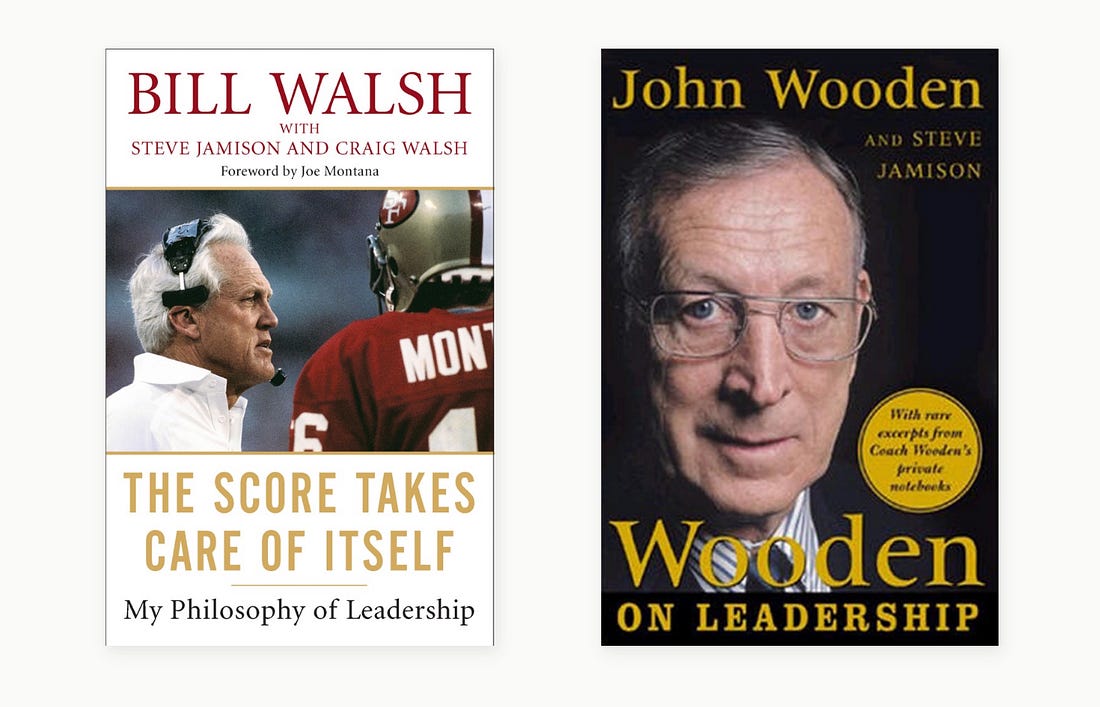
When I asked Pete to recommend a book, he turned to two coaches: Bill Walsh of the San Francisco 49ers and John Wooden of UCLA. Walsh’s book is The Score Takes Care of Itself, a classic Wooden tome is On Leadership. Pete’s answer brought us back to teaching and coaching, both of which have been big parts of his life.
 |
Tangents
What I’m reading, watching, and into this week:
Training a small model to autocorrect my text messages more accurately. So far…the gains are modest :)
Empire of Pain by Patrick Radden Keefe. I don’t usually read non-fiction in my spare time, but I’ve “enjoyed” (a strange word for so bleak a story) this excellent reporting of the Sackler family and the opioid epidemic.
Playing with the models’ 3D capabilities to spin up an Italo Calvino-themed personal website (in progress).
—Mario
Every timestamp
00:00 Intro
02:24 GEN-1.5 and one-shot learning
08:55 What makes a task difficult
10:53 Dexterity in robotics
14:53 Matt Mason’s definition of a hand
17:34 Giving robots a sense of touch
20:30 Growing up in a family of technologists and scientists
22:46 What drew Pete into robotics
27:38 Generalist’s founding thesis and what sets it apart
32:17 Protecting simplicity
35:01 How Generalist’s data collection has evolved
35:30 Generalist’s scaling philosophy
39:53 Generalist’s build-versus-buy philosophy
42:15 Balancing general intelligence with commercial deployment
44:24 Why Pete is betting on dexterity
47:33 The durability of the robotics application layer
49:09 Open-weight robotics models and data flywheels
50:52 Geopolitics, safety, and alignment
52:42 The parallels between teaching humans and robots
1:00:05 The timeline for robotics progress and adoption
1:03:37 Book recommendations
Listen or watch on YouTube • Spotify • Apple Podcasts
Pete’s complete reading list
The Score Takes Care of Itself: My Philosophy of Leadership: https://www.amazon.com/Score-Takes-Care-Itself-Philosophy/dp/1591843472
Wooden on Leadership: How to Create a Winning Organization: https://www.amazon.com/Wooden-Leadership-Create-Winning-Organization/dp/0071453393
Other resources
Generalist: https://generalistai.com
Proprioception: https://en.wikipedia.org/wiki/Proprioception
Cutaneous receptor: https://en.wikipedia.org/wiki/Cutaneous_receptor
Fukushima nuclear accident: https://en.wikipedia.org/wiki/Fukushima_nuclear_accident
The bitter lesson: https://www.cs.utexas.edu/~eunsol/courses/data/bitter_lesson.pdf
Where to find Pete Florence
LinkedIn: https://www.linkedin.com/in/peteflorence
Website: https://www.peteflorence.com
Subscribe to the show
I’d love it if you’d subscribe and share the show. Your support makes all the difference as we try to bring more curious minds into the conversation.
Production and marketing by penname.co. For inquiries about sponsoring the podcast, email [email protected].
You're currently a free subscriber to The Generalist. For the full experience, upgrade your subscription.
| ||||||||||